How to Create Viral Video Intros in 2025: The Complete Guide to Stopping the Scroll
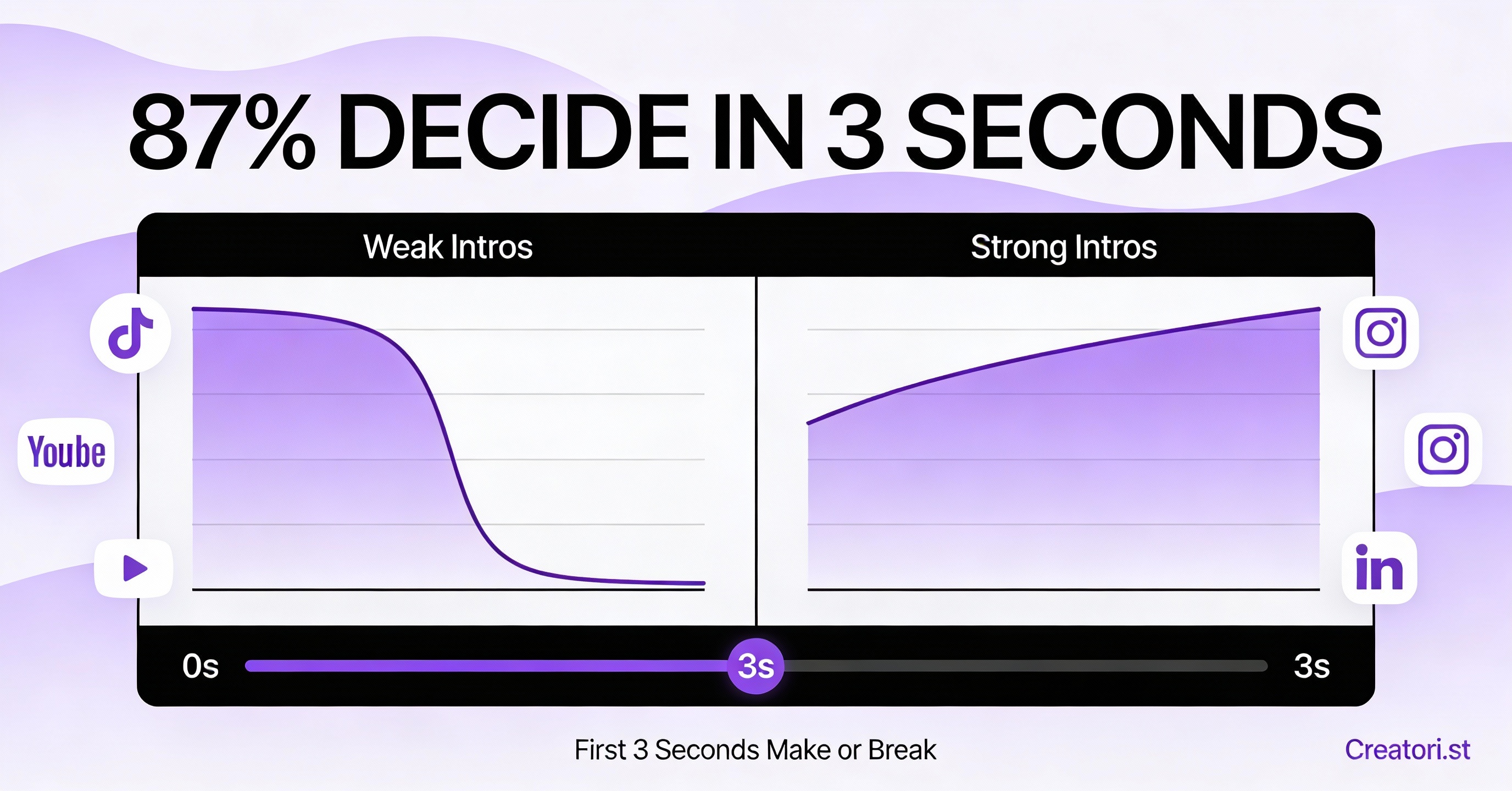
Your first 3 seconds determine everything. On TikTok, Instagram Reels, and YouTube, 87% of viewers decide whether to watch or scroll away before your content even gets interesting. That’s not a limitation—it’s your greatest opportunity.
A strong introduction is the difference between a video that reaches 100 people and one that reaches 100,000. Yet most creators overlook it entirely, burning clicks on weak openings, generic greetings, and slow builds. The result? Videos that lose retention faster than viewers can swipe away.
This guide shows you the exact formula top creators use to hook audiences instantly, plus how to use AI tools like Creatori.st’s Introduction Generator to craft platform-optimized intros that work—no guesswork required.
In This Guide, You’ll Discover:
- Why Your Video Intros Are Failing
- The Formula: Why Creators Are Missing the Obvious
- How to Create Intros That Hook
- Why AI Introduction Generators Actually Work
- Platform-Specific Introduction Formulas
- Real-World Case Studies
- Testing Your Intros: The Data-Driven Approach
- How Creatori.st’s Introduction Generator Accelerates This Process
- Complementary Tools
- Common Intro Mistakes That Tank Retention
- The Bottom Line: Your Intro Is Your Leverage Point
- Next Steps: Start Testing Today
Why Your Video Intros Are Failing (And How It’s Costing You Growth)
Before you can fix your intros, you need to understand why they matter so much to algorithms and viewers.
The 3-Second Window That Changes Everything
When someone hovers over your video thumbnail, they see a 3-second autoplay preview on mute. In those 3 seconds, before sound, captions, or context, they decide: watch or scroll?
YouTube prioritizes videos where viewers watch past the 30-second mark. TikTok’s algorithm weighs the first 15% of watch time heavily to determine if your content is engaging enough to recommend broadly. Instagram Reels use similar signals—strong opening retention gets exponentially more distribution.
Here’s what makes this powerful: videos with strong 3-second hooks maintain 80-90% viewer retention through the opening, while weak intros drop to 23% retention within the same timeframe. That’s a 340% difference in engagement, and it compounds across the entire video.
The Hidden Cost of Weak Intros
You’ve probably experienced this yourself: you’re scrolling, a video thumbnail catches your eye, you click, but within 10 seconds you’re gone. The thumbnail did its job. The title worked. But the intro failed to deliver.
Here’s the math: if 50 people click your video but 45 leave in the first 30 seconds, you’ve wasted your CTR and created a negative signal to the algorithm. Each early exit tells YouTube/TikTok/Instagram: “This content didn’t match its promise. Show it to fewer people next time.”
But when an intro delivers immediately—when it matches your thumbnail promise and hooks the viewer in the first 5 seconds—watch time extends, completion rates climb, and algorithms respond by recommending your video to 2x, 3x, sometimes 10x more people.
Why Generic Intros Kill Growth
Most creators open with variations of the same five phrases:
- “Hey guys, thanks for watching…”
- “So today I’m going to talk about…”
- “Welcome back to my channel…”
- “Before we start, here’s a quick update…”
- Long logo animations or slow transitions
Data from actual creator testing shows these generic openings perform 30-40% worse in retention than intros that start with immediate value or curiosity. They’re safe. They’re boring. They cost you viewers.
The best-performing intros don’t introduce the creator—they introduce the problem, the promise, or the payoff. They answer the question viewers unconsciously ask: “Is this worth my next 30 seconds?”
The Formula: Why Creators Are Missing the Obvious
If you’ve been struggling with low retention, your intro likely commits one of three mistakes:
1. Not Matching Your Promise Your thumbnail promises “5 secrets that changed my income,” but your intro says “So, this week I want to share something with you.” The viewer clicked for secrets. They got a story setup. The mismatch signals a broken promise, and they leave.
2. Leading With Yourself, Not Value Your audience doesn’t care who you are in the first 3 seconds. They care what they’ll gain. Yet most intros waste those crucial seconds on creator introductions that could come later: names, channel names, request for subscriptions. Your value proposition is the only introduction that matters at the start.
3. Missing Visual Proof Half your audience watches on mute. If your first 5 seconds are just you talking—with no text overlay, no B-roll, no visual confirmation of your promise—they’ve already decided to leave. You need both words and visuals that immediately prove you’re delivering what they clicked for.
How to Create Intros That Hook: The Step-by-Step Process
Here’s the exact framework used by creators who consistently hit 50%+ retention rates:
Step 1: Match Your Intro to Your Thumbnail Promise
Before you write a single word, know exactly what your thumbnail promises.
If your thumbnail shows a dramatic before-and-after transformation, your intro must immediately reference that transformation or show it. Not after a story. Not after context. In the first 5 seconds.
Example from a fitness creator:
Weak: “Hey everyone, I’m excited to share my fitness journey with you today. It’s been quite the adventure, and…”
Strong: [Show dramatic before-and-after photos] “I lost 50 pounds in 6 months without stepping foot in a gym. Here’s the one thing nobody tells you…” [Shows the key insight]
The second version delivers the promise instantly. Viewers who clicked for transformation see immediate proof that this video has it.
Step 2: Open With Curiosity or Immediate Value (Within 5 Seconds)
Your opening line should do one of these three things:
A) Ask a Specific Problem Question “Why does your engagement drop 40% after the first month?” beats “Let’s talk about growth strategies.”
B) State a Surprising Fact or Counterintuitive Claim “95% of creators get this part completely wrong…” or “Most of what you learned about TikTok in 2024 is already outdated…”
C) Deliver an Immediate Insight or Tool Give viewers something they can use right away. “Here’s the one metric you should obsess over instead of follower count…” proves immediately that the video has value.
Why these work: they create what researchers call a “curiosity gap”—the space between what viewers know and what they want to know. It pulls them forward.
Step 3: Reinforce With Text Overlays and Visuals
Remember: 50% of your viewers watch without sound. Your intro must work on mute.
Use bold text overlays to highlight your opening promise. Show relevant B-roll, graphics, or action that proves what you’re claiming. If you’re about to reveal a productivity hack, show a glimpse of it.
This does three things:
- It confirms your promise visually
- It keeps viewers engaged during the talking portions
- It works for both sound-on and sound-off viewers
Step 4: Get Specific—Use Platform and Audience Data
Different platforms demand different intro styles.
YouTube Intros (8-15 seconds)
- Set up context and your unique angle
- Introduce the roadmap early (“Here’s what we’re covering…“)
- Use your keyword in the first 10 seconds for SEO
- Build authority and credibility
TikTok/Instagram Reels (1-3 seconds)
- Pure visual + verbal hook
- No context—jump straight to action or intrigue
- Use pattern interrupts (text, cuts, zooms) every 3-5 seconds
- Test multiple hook styles to see what resonates
LinkedIn Intros (1-2 sentences)
- Establish immediate professional relevance
- Use industry language and credibility markers
- Address pain point specific to business audience
- Lead with professional insight, not personal story
YouTube Shorts (3-5 seconds)
- Same energy as TikTok intros
- Hook first, context later
- Use trending audio and effects
- Optimize for loops and rewatching
Why AI Introduction Generators Actually Work (And When They Don’t)
Here’s what you need to know: an AI intro generator is only as good as the input you give it.
Bad input → generic, forgettable output. Good input → platform-optimized, audience-targeted hooks that actually convert.
Creatori.st’s Introduction Generator takes your platform choice, topic, main point, and target audience, then generates multiple intro variations tailored to how each platform’s algorithm and audience consume content.
The advantage? You get platform-specific pacing, hooks, and tone instantly. Instead of writing five different intros for YouTube, TikTok, LinkedIn, and Instagram manually, the tool creates them in seconds.
But here’s the key to using it right:
How to Use an Introduction Generator Effectively
Step 1: Know Your Exact Main Point Don’t just input your topic. Input the specific insight, problem, or promise you’re opening with.
Instead of: “Topic: Social Media Growth” Use: “Main Point: Why your engagement drops after 30 days and the one metric to fix it”
Step 2: Be Specific About Your Audience “Entrepreneurs who’ve been creating for 3-6 months, hitting a plateau, want to break through to 10K followers”
beats
“Content creators”
The more specific your audience, the more targeted your intro will be.
Step 3: Generate Multiple Variations Create 3-5 different intro variations. They’ll use different hook styles: curiosity gap, bold claim, question, social proof, pattern interrupt. Test them. One will outperform the others by 20-40%.
Step 4: Adapt, Don’t Copy Directly Take the AI-generated intro and make it yours. Add your specific language, your personality, your examples. The AI gives you the structure and hook psychology. You add the authenticity.
Platform-Specific Introduction Formulas
Here’s how to structure intros for maximum retention on each major platform:
YouTube: The Promise-Proof-Plan Framework
Formula: Promise (what you’ll learn) → Proof (credibility or preview) → Plan (the roadmap)
All within 8-10 seconds.
Example: “In the next 10 minutes, I’m going to show you the exact sequence I used to go from 500 subscribers to 10,000 in 30 days. Most creators skip step 3, which is why they plateau. Here’s the plan…” [Show numbered checklist]
Why it works: YouTube viewers want context and authority. This intro establishes you’re credible, delivers value fast, and sets clear expectations.
TikTok/Instagram Reels: The Immediate Hook + Visual Burst
Formula: 1-second visual hook + 1-second verbal hook + Pattern interrupt within 3 seconds
Example: [Visual: Show shocking stat on screen][Verbal: "90% of creators don't know this..."] [Pattern interrupt: Quick cut, text overlay, music shift]
Why it works: TikTok users have infinite scroll alternatives. You have milliseconds. Visual + verbal sync, then break the pattern every 3-5 seconds.
LinkedIn: The Credibility + Problem-Solution Combo
Formula: Professional credibility/context → Specific problem → Clear takeaway
Example: “After advising 200+ companies on their content strategy, I noticed something: 95% of the best posts follow the same structure. Here’s the pattern…”
Why it works: LinkedIn is professional but personal. Establish authority first, then deliver insight. LinkedIn users tolerate longer intros (5-8 seconds) if they promise business value.
YouTube Shorts: Hooks That Loop
Formula: Hook so strong it works on infinite repeat
Example: [Visual: Surprising transformation or action][Verbal: "Wait until the end"] [Pattern: Builds towards payoff viewers want to see again]
Why it works: Shorts auto-loop. If your intro works on repeat, the algorithm pushes it harder. Simple curiosity (what happens next?) drives loops.
Real-World Case Studies: Before vs. After
Case Study 1: Fitness Creator, 5% → 47% First-30-Second Retention
Before (2% retention through 30 seconds): “Hey everyone, I hope you’re having a great day. Today I want to share my fitness journey with you. It’s been quite the adventure, and I’m really excited to tell you all about it…”
After (47% retention through 30 seconds): [Immediately shows before/after photos] “I lost 50 pounds in 6 months without stepping foot in a gym. Here’s the one thing nobody tells you…”
What changed: Removed creator greeting and personal context. Led with the transformation viewers clicked to see. Added visual proof. Result: 23x improvement in initial retention, 340% boost in overall watch time.
Case Study 2: Business Tutorial, 5% → 52% Retention
Before (5% retention): “Welcome back to my channel where I teach business strategies. In today’s video, we’re going to be covering some important concepts about…”
After (52% retention): [Shows bank account screenshot with large number] “This strategy made me $10K in 30 days. Most people get it completely wrong because they skip this one step…”
What changed: Removed generic channel greeting. Led with specific result (number + timeframe). Promised a counterintuitive insight. Added credibility signal (bank account proof). Result: 10x increase in initial retention, 67% boost in overall completion rate.
Testing Your Intros: The Data-Driven Approach
Don’t guess. Test.
Week 1: Test 3 Different Hook Styles
Take one topic and create three versions, each with a different opening:
Version 1: Question Hook “Why is your engagement dropping 40% after your first month of posting?”
Version 2: Bold Claim/Stat “90% of creators are doing this wrong, and it’s killing their growth…”
Version 3: Immediate Promise “In the next 8 minutes, I’ll show you the exact system I use to turn cold followers into customers…”
Post all three. Track which hook gets the strongest retention in the first 5-15 seconds using platform analytics.
Week 2: Double Down on Winner + Test Audio Variations
Take your winning hook. Now test:
- Trending audio vs. niche audio
- Different background visuals
- Different text overlay styles
The same hook psychology works across variations. You’re now testing execution.
Week 3: Reuse Winning Hooks + Cross-Promote
Once you identify your best-performing hooks, reuse them.
- Same hook, different topic
- Same hook, different platform
- Same hook, different creator angle
Winning patterns compound. Your best 3 hooks might generate 50%+ of your total views.
How Creatori.st’s Introduction Generator Accelerates This Process
Manually writing and testing 15+ intro variations takes 2-3 hours. Using an introduction generator cuts that time to 5-10 minutes.
The workflow:
- Input your platform, topic, main point, and target audience
- Get 5-8 AI-generated intro variations in different styles
- Pick your top 3 favorites
- Personalize with your voice/examples
- Post and test
Instead of spending hours writing, you spend hours testing and optimizing what actually works.
This is especially powerful if you’re creating multiple pieces of content weekly. One creator we know went from posting 2 videos/week to 8 videos/week by cutting her intro-writing time from 90 minutes to 15 minutes per piece.
Complementary Tools: Complete Your Content Strategy
A strong intro is just the beginning. Your title, caption, and overall structure matter equally.
Create Better Titles Strong titles set up the promise your intro delivers on. Use Creatori.st’s Title Generator to create platform-specific headlines that get clicks and match your intro hook.
Generate Engagement-Driving Captions Your intro works for the first 5 seconds. Your caption works for clicks and findability. Use Creatori.st’s Caption Generator to create captions optimized for each platform—Instagram, TikTok, LinkedIn, YouTube—with natural keyword placement and calls-to-action built in.
The Full System Title (gets clicks) → Intro (keeps them watching) → Caption (drives engagement and shares) = complete content optimization.
Common Intro Mistakes That Tank Retention
Knowing what not to do is half the battle.
1. The Delayed Promise
Your thumbnail promises “5 secrets,” but the secret doesn’t appear until minute 2. Viewers are gone by then.
Fix: Show or mention your first secret in the first 8 seconds.
2. Introducing Yourself Instead of Your Value
“Hi, I’m [Name], and welcome to my channel where I talk about [Topic]…”
Fix: Skip the introduction. Jump straight to value. You can introduce yourself after the hook.
3. The Slow Build
You spend the first 20 seconds setting up context, backstory, or jokes. By then, half your audience has scrolled.
Fix: Lead with the payoff, then provide context.
4. Visual Mismatch on Mute
Your words are great, but your video is just a static shot of your face. Viewers watching without sound see no reason to stay.
Fix: Use text overlays, B-roll, graphics, or visual action that proves your promise without sound.
5. Generic Language That Could Apply to 100 Other Videos
“Today I’m going to show you how to grow on social media…”
Fix: Be specific. “Here’s why your TikTok engagement dropped 60% in November and the one setting you need to change.”
6. Asking for Engagement Too Early
“Don’t forget to like and subscribe!” in the first 10 seconds doesn’t work. First deliver value, then ask.
Fix: Ask for subscriptions and likes after you’ve proven value (20-30 seconds in).
The Bottom Line: Your Intro Is Your Leverage Point
Here’s what separates creators who plateau at 10K followers from those who grow to 100K+: they obsess over the first 5 seconds.
Your thumbnail gets the click. Your title sets the expectation. But your intro determines whether that click converts to watch time. And watch time determines everything—algorithmic reach, monetization, audience trust, and growth.
A small improvement to your intro—moving from a generic greeting to a specific problem or promise—might only increase retention by 10-15%. But across 10 videos/month, that’s 2-3 extra hours of total viewer engagement. That compounds into algorithmic favor, more recommendations, and exponential reach growth.
You don’t need to be a perfect public speaker. You don’t need fancy equipment. You just need to:
- Know your promise (what the viewer clicked for)
- Deliver it immediately (first 5 seconds)
- Provide proof (visual + verbal)
- Create curiosity (reason to keep watching)
This framework works for YouTube, TikTok, Instagram, LinkedIn, and every other platform. The timing changes. The visual style changes. But the psychology remains the same.
And if you want to skip the guesswork and get platform-optimized intros in minutes, use AI. Test them. Keep what works. Discard what doesn’t.
That’s how modern creators grow.
Next Steps: Start Testing Today
- Use Creatori.st’s Introduction Generator to create 3-5 intro variations for your next video
- Pick the strongest hook and personalize it with your voice
- Track retention in your first 5 and first 30 seconds
- Test different hooks weekly until you find what works for your audience
- Combine with optimized titles from Creatori.st’s Title Generator and captions from Creatori.st’s Caption Generator for complete content optimization
Your next 3 seconds determine your next 3 months of growth. Make them count.
Sources
- Scenith (2025). “The 3-Second Rule: Why 87% of Viewers Skip Your Videos.”
- Opus Pro Blog (2025). “Ideal TikTok Length & Format for Retention (Data-Backed).”
- YouTube. (2025). “How the YouTube algorithm works.”
- YouTube Retention Metrics Analysis.
- Content Studio. (2025). “Social Media Hooks: 30+ Proven Examples.”
- SoTrender. (2025). “How to Get More Views on TikTok: 4-Week Plan.”
- YouTube Video School. (2025). “YouTube Intro Mistakes That Kill Views.”
- Planable. (2025). “6 Social Media Hooks That Work in 2026.”
- YouTube SEO Guide. (2025). “How to Optimize YouTube Videos.”
- Creatori.st Introduction Generator. “Platform-specific introduction optimization.”
- Content Creation Efficiency Analysis.
- Creatori.st User Case Study.
- YouTube Retention and Algorithmic Distribution Analysis.
About Creatori.st
Creatori.st is the free AI-powered platform for creators, marketers, and small business owners. Our tools—including the Introduction Generator, Caption Generator, and Title Generator—help you create content that stops the scroll and keeps audiences engaged. No signup required. No limits. Just powerful tools that work.
Start generating viral-ready intros today at creatori.st/en/introduction.