Meta Ads on $5–$20/Day: A Creative‑First System (Punch‑Proof‑Push Framework)
Meta ads can work on $5–$20 per day if the strategy is creative‑first, data‑driven, and structurally simple. This guide combines the Punch‑Proof‑Push framework, small‑budget campaign best practices, and low‑budget tactics to help creators, small brands, and solo marketers turn modest spend into predictable results.
Table of Contents
- Why Small Budgets Can Still Win on Meta
- What Counts as a “Small” Meta Ads Budget?
- Core Philosophy: Creative System > Media Buying Tricks
- The Punch‑Proof‑Push Framework (Adapted for Low Budgets)
- Low‑Budget Campaign Structure That Actually Works
- Targeting Tactics for $5–$20/Day
- Creative Tactics: How to Outperform Bigger Budgets
- Budget, Bidding, and Optimization Cadence
- Performance Benchmarks and Example Setups
- How Creatori.st Fits into This System
- FAQs About Small‑Budget Meta Ads
Why Small Budgets Can Still Win on Meta
Multiple performance advertisers report that accounts spending $5–$25 per day can still generate leads and sales, provided they minimize variables and focus on a clear testing system rather than random experimentation.
The key shift is to treat a small budget as a proof‑of‑concept engine: find 1–3 winning creatives and a profitable cost per acquisition, then reinvest profits rather than trying to “do everything” from day one.
What Counts as a “Small” Meta Ads Budget?
For practical purposes, it helps to separate tiny, small, and scalable budgets based on how much reliable data each can generate.
Budget Levels and What They’re Best For
| Daily Budget Range | Best Use Case | Expected Outcome |
|---|---|---|
| $5–$10/day | Proof of concept, basic traffic | Slow, volatile data; high patience needed |
| ~$25/day | Testing offers & creatives | Actionable data within 2–4 weeks |
| $50–$100/day | Faster learning and scaling signals | Stable optimization possible |
Meta’s optimization patterns suggest that the algorithm tends to stabilize once an ad set gets closer to 30–50 conversions per week, which usually implies at least $20–30 per day per ad set in many verticals. This is why oversplitting a tiny budget across many ad sets is so damaging.
Core Philosophy: Creative System > Media Buying Tricks
Modern performance data and practitioner experience converge on one principle: creative quality and systematic testing drive roughly 70–80% of ad performance, while bidding tactics and micro‑optimizations contribute the rest.
For low‑budget Meta ads, the fastest way to waste $5–$20/day is to:
- Launch too many ads at once
- Test random hooks without a framework
- Judge success purely on a few days of volatile ROAS
Instead, the highest‑ROI approach is to build a repeatable creative system: a pipeline that finds early signals cheaply, proves winners across audiences, then scales those winners with controlled risk.
The Punch‑Proof‑Push Framework (Adapted for Low Budgets)
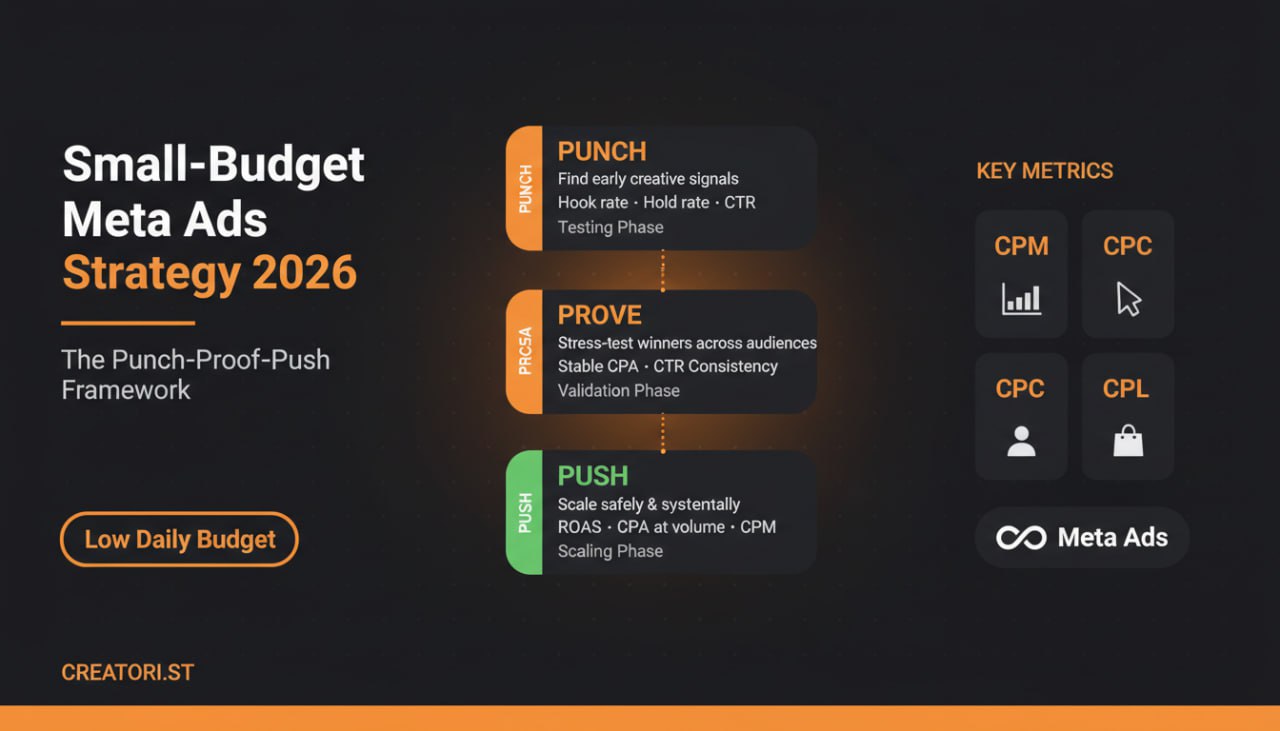
The Punch‑Proof‑Push framework is a three‑phase system for creative testing and scaling that fits neatly with what Meta’s learning phase and auction model already do.
Punch: Find Early Creative Signals
Goal: Discover which concepts have real potential before worrying about full ROAS.
Tactics:
- Start with 10–25 truly unique creatives over time, not just small variations of the same video.
- Focus on different formats (UGC, product demo, “us vs. them” comparison, testimonial, carousel), not only different lines of copy.
- Optimize for Sales or Leads from day one, but judge creatives first by:
- Hook rate (first 3 seconds watched)
- Hold rate (25–50% video completion)
- Outbound CTR and CPC
On small budgets, the best early‑phase creatives sometimes have no purchases yet but excellent attention and click signals, especially if the audience or landing page still needs refinement. Killing those too early is a classic low‑budget mistake.
Timing rule: Let new ads run for 3–7 days without edits unless performance is catastrophically off (for example, double the realistic CPA benchmark). This avoids constantly resetting the learning phase.
Prove: Stress‑Test Winners Across Audiences
Goal: Confirm that early winners are real and not flukes from a particular micro‑audience.
From the Punch phase, select the top 3–5 creatives based on click and engagement metrics, then:
- Test them in the same campaign across a limited set of audiences:
- Broad / Advantage+
- 1–3 tightly relevant interest groups
- 1–2 lookalike audiences if you have seed data (buyers, leads, or high‑intent visitors)
- Watch for stability in CPA and CTR as you rotate through these audiences. True winners tend to maintain reasonable costs and click‑through even when shown to new segments.
If a creative only performs in one very narrow audience and collapses elsewhere, treat it as a situational win, not the foundation for scaling.
Push: Scale Safely and Systematically
Goal: Gradually increase spend on proven creatives without breaking ROAS.
When at least one creative shows consistent CPA and CTR across multiple audiences:
- Move it into a dedicated scaling setup (still as simple as possible):
- One main scaling campaign
- One or two ad sets (e.g., broad + strongest custom/lookalike)
- Only the proven creatives plus structured variations (new hooks, shorter edits, angle tweaks)
- Start with Lowest Cost bidding to maximize conversions, then consider switching to Cost Cap once there is a solid handle on profitable CPA.
Guardrails:
- Increase budgets gradually (for example, 20–30% every few days) rather than doubling overnight; sudden jumps can destabilize delivery on small accounts.
- Use audience exclusions (past purchasers, recent engagers) so scaled ads focus on fresh prospects rather than recycling warm traffic.
This aligns creative iteration with algorithmic learning instead of fighting it.
Low‑Budget Campaign Structure That Actually Works
Real‑world data and practitioner experience converge on a surprisingly minimal structure for low‑spend Meta ads:
- 1 campaign
- 1 ad set for cold traffic to start
- 3–5 creatives only
Once there is consistent spend and a bit of warm traffic, a second ad set for retargeting (site visitors, add‑to‑carts, IG/FB engagers) can be added while keeping everything under one campaign.
Many small‑budget accounts also find that ABO (ad set budget optimization) offers better control than CBO at very low spend, because budget isn’t prematurely funneled into one ad set before others have a chance to prove themselves.
Targeting Tactics for $5–$20/Day
Targeting decisions determine whether a small budget reaches people who can realistically convert. Modern guidance is to lean on Meta’s improved AI, then add precision only where it clearly helps.
Recommended order of operations:
- Broad / Advantage+ targeting for offers with wide appeal
- Laser‑focused interests for niche products or local services
- Lookalike audiences once there is a seed
- Simple retargeting once pools reach meaningful size
Overspecific stacking on top of a $5–$10/day budget tends to drive CPMs up and leave the algorithm with too few people to learn from.
Creative Tactics: How to Outperform Bigger Budgets
Creators and small brands cannot outspend larger competitors, but can out‑relevance them.
Hyper‑Specific Positioning
Examples:
- “Meta ads strategy for solo fitness coaches with $10/day”
- “Facebook ads for local cafés that want more weekday customers”
- “Meta ads system for creators selling Notion templates”
Model What Already Works with Meta Ads Library
- Look for ads running 6+ months
- Identify repeating patterns (hooks, offers, proof)
- Rebuild the structure with your own messaging
Turn Organic Content into Ad Tests
- Identify organic posts with high watch time / saves / shares
- Add a clear CTA
- Run them in Punch phase
Budget, Bidding, and Optimization Cadence
Choosing the Right Bid Strategy
- Start with Lowest Cost
- Move to Cost Cap once you know CPA targets
- Avoid Bid Cap until you have lots of data
Daily Budget Guidelines by Stage
| Stage | Typical Daily Budget | Main Focus |
|---|---|---|
| Punch (testing) | $5–$25/day | Signals: CTR, CPC, hook & hold rates |
| Prove (validation) | $25–$50/day | Stable CPA across different audiences |
| Push (scaling) | $50–$100+/day | ROAS, CPA at volume, audience exclusions |
Optimization Cadence
- Let setups run 3–7 days
- Batch changes (one variable at a time)
- Avoid daily tinkering
Performance Benchmarks and Example Setups
Typical Meta Cost Benchmarks (Indicative)
| Metric | Typical Range (All Industries) |
|---|---|
| CPM | $8–$15 |
| CPC | $0.50–$1.50 |
| CPL | $5–$25 |
| CPA | $20–$80 |
Example Setup: €5–€10/Day Creator Funnel
- Campaign: Sales
- Ad Set: Broad/Advantage+
- Creatives: UGC talk-to-camera, demo Reel, carousel
Example Setup: €20–€30/Day Service Business
- Campaign: Leads or Sales
- Ad Sets: Interest + Retargeting
- Creatives: testimonials + educational explainers
How Creatori.st Fits into This System
- During Punch, generate multiple hook/angle variations quickly.
- Repurpose winning organic posts into Meta-ready ad copy faster.
FAQs About Small‑Budget Meta Ads
1. What is the minimum daily budget to run effective Meta ads?
$5–$10/day for proof-of-concept; ~$25/day for more stable learning.
2. Is $5/day on Meta ads even worth it?
Yes, but results are slower and noisier; optimize for learning first.
3. Should small budgets use Traffic or Awareness campaigns?
No — optimize for Sales/Leads.
4. How many ads should run at once on a low budget?
3–5 per ad set.
5. How long should ads run before making optimization decisions?
Typically 3–7 days.
6. When does it make sense to use Cost Cap or Bid Cap?
Cost Cap after you know CPA; Bid Cap is advanced and can throttle delivery.